Virus investigator: I was afraid of affecting my family. I didn’t dare to enter the house for more than 40 days.
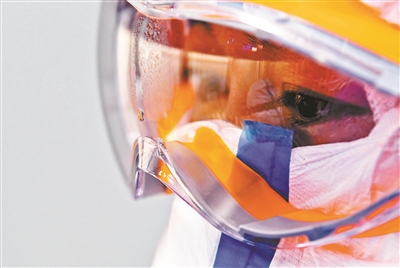
At the room temperature of 25℃, plus the airtight protective clothing, Wang Zhaoe could feel the sweat dripping down, and a layer of fog had already appeared on the goggles.

Wang Zhaoe wrote down the sample number on the cover of each EP tube and collection column with a pen, and put it in the sample grid in strict accordance with the same position.

After half an hour, Wang Zhaoe took the sample out of the water bath, and Yu Hong took it and put it in the biosafety cabinet.
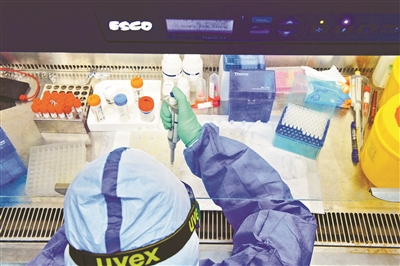
Biosafety cabinet is the most important equipment in the laboratory, and Yu Hong puts her hands into it to extract nucleic acid.

Yu Hong (left) and Wang Zhaoe have been working regularly since the outbreak. That night, the main operator was Yu Hong, and Wang Zhaoe was an assistant, responsible for sample checking and centrifugation.
Win the epidemic prevention and control war
After collecting samples, how was Covid-19 detected? Nucleic acid detection is an important part of COVID-19’s judgment, and everyone who is sampled has been waiting for a "verdict": whether the nucleic acid test is negative or positive. In the microbial detection laboratories of CDC at all levels, there are such a group of "virus investigators" who are burying their heads in the microscopic world invisible to the naked eye every day to find the virus. They are not in direct contact with patients, but they are trying to peel off the true face of the virus and provide scientific, effective and powerful "big data" support for the handling of the epidemic. A sample involves the overall situation of epidemic prevention and control, and they are responsible for each sample. From January 20th to now, 15 "soldiers" from the Microbiology Laboratory of Fengtai District Center for Disease Control and Prevention have been fighting for more than 40 days, 7×24 hours a week, and have tested thousands of samples … … Recently, Beijing Youth Daily reporters put on protective clothing and followed the "virus investigators" into the front line of virus detection to uncover their mystery.
The test results are related to personal and overall psychological pressure.
At 16: 00 pm on March 2, the second-level biosafety laboratory of Fengtai District Center for Disease Control and Prevention — — Outside the respiratory virus testing room, seven sample transfer boxes are stacked in a row on the ground. Some samples have just been collected by the district CDC, and some have been specially sent by local hospitals, with sputum and throat swabs, a total of 19 samples, all sealed in transfer boxes and ready to be sent to the laboratory for testing — — The owners of these samples are waiting for a verdict.
Covid-19 is highly contagious, and experiments must be carried out in strict accordance with biosafety standards. In the dressing room ten meters away, Yu Hong and Wang Zhaoe, virus detection technicians on duty, are working hard to change protective clothing. Their task is to extract all the nucleic acids from these 19 samples. Yu Hong has been in the Microbiological Laboratory of Fengtai District CDC for 14 years, and Wang Zhaoe is also a veteran with 9 years of work experience. The two sisters have been working regularly since January 20th. That night, the main operator was Yu Hong, and Wang Zhaoe was an assistant, responsible for sample checking and centrifugation.
Hat, shoe cover, disposable isolation gown, first layer gloves, N95 mask, disposable medical protective clothing, second layer gloves, disposable medical boot cover, second layer shoe cover, splash-proof isolation gown, goggles & HELIP; … Entering the laboratory means that there is a risk of exposure to the virus. Yu Hong and Wang Zhaoe check each other’s protective clothing at any time.
Yu Hong said, "The test results in our hands are not only related to the owner of the sample, but also to the life safety of people around him, as well as the overall situation of epidemic prevention and control. In the early days of the epidemic, the understanding of this disease was not so clear, and our psychological burden would be particularly heavy, especially when it was positive. " At this time, Wang Zhaoe joked: "At the beginning, when I was negative, I suspected that the experiment was not done well. When I was positive, I was afraid that I would be exposed." At the beginning of the epidemic, they were always in this tangled and contradictory state, so they always recalled every step they had done, whether they had done it right or not.
It takes nearly 20 minutes to take out the sampling tube and disinfect it at the same time.
After more than ten minutes of preparation, at 17 o’clock sharp, Yu Hong and Wang Zhaoe were dressed, and the reporter of Beiqing Daily also put on protective clothing and followed them through two protective doors to enter the laboratory. Next to the outer protective door, there is a transparent glass, through which Wei Xiuxia, a staff member sitting outside, can observe the internal state of the laboratory, and can meet at any time if there is an accident. On one side of the glass, there is a small transfer window through which samples have been sent to the laboratory in turn.
This laboratory is about 20 square meters, and the most important equipment in it is the biosafety cabinet about two meters high in the corner, which is where Yu Hong will extract nucleic acid. This biological safety cabinet only allows experimenters to put their hands into it for operation. The cabinet is equipped with a special internal circulation system and a special filter membrane, which can ensure the isolation of the air inside the cabinet from the air outside the cabinet and prevent viruses from running outside the cabinet.
Ready, Wang Zhaoe took the chlorine-containing disinfectant that had just been prepared and sprayed seven boxes containing samples in turn for disinfection. Open the box, take out the yellow 95 kPa sealed can, and pass it to Yu Hong after disinfection. Yu Hong has been seated in front of the biosafety cabinet. She took the jar, slowly opened the lid, took out the sealed bag, and then carefully sprayed the front and back sides of the bag with disinfectant. Through the sealed bag, you can see the throat swab and sputum samples inside. The reporter of Beiqing Daily found that it took nearly 20 minutes to take out the 19 samples from the transfer box just to completely inactivate the possible Covid-19 on the surface of each layer of sample packaging.
At room temperature of 25℃ and protective clothing, sweat dripped down.
In order to prevent the virus infection from harming the experimenters, the samples should be inactivated before opening the sampling tube every time. Wang Zhaoe put the packed samples into a water bath pot for 30 minutes at 56℃. Later, she wrote "17: 22-17: 52" in the blank of the small card of the experimental platform to remind herself of the time. Going back and forth, getting up, disinfecting and handing samples, Wang Zhaoe’s goggles have been fogged. With a room temperature of 25℃ and a closed protective suit, Wang Zhaoe said that the close-fitting coat was soaked and he could feel the sweat dripping down his body.
Taking advantage of this half-hour gap, the two began another crucial preparatory work. On one side of the experimental platform, seven white sample boxes with grids have been set up. In each box, 20 white EP tubes and collection columns are placed in sequence, 19 for processing samples and 1 for negative control to ensure the accuracy of the experiment.
There are a total of 19 samples on the seven sample delivery sheets, and the information such as the submitting unit, the name of the sample person, whether the sample type is throat swab or sputum, and the corresponding sample number has been marked on them. The two of them wrote down the sample number on the cover of each EP tube and collection column with a pen, and put it in the sample grid in strict accordance with the same position. For example, the sample number of Wang’s throat swab is fixed to 1011, and the position of the sample box is fixed, which is fixed at the first row.
At this point, there are still more than ten minutes before the inactivation is completed, and the two of them are sitting in the corner to rest. "This is a closed laboratory, and wearing a N95 mask will cause great resistance, so we mostly rely on eye contact." Wang Zhaoe calmed herself down, expecting the fog on the goggles to disperse quickly.
The risk of removing outer packaging layer by layer increases little by little.
Half an hour later, Wang Zhaoe took the sample out of the water bath pot, and Yu Hong took it and put it in the biosafety cabinet, and the sealed bag was still steaming. After standing for 10 minutes, it took nearly 20 minutes to disinfect, open the sealed bag, take out the sampling tube, disinfect, mark the number and put it in the sample rack, and then all these throat swabs and sputum samples were taken out and packed neatly.
The outer packaging is removed layer by layer, and the risk is increasing little by little. If there is Covid-19 in the sample and it has not been completely inactivated in the early stage, then the next step is the most dangerous. Six of the samples are sputum, which must be diluted before the next treatment because it is thick. Yu Hong must first add sputum digestive juice to these six samples. She held the lower part of the sampling tube with her left hand, and the cover with her right hand. She turned the tube carefully and slowly for about three or four turns, opened the cover, added sputum digestive juice in proportion, and then covered it, allowing the sputum to stand and fully dilute.
Yu Hong said that although it has been inactivated, no one can guarantee whether there is any inactivated virus attached to the cover. In order to avoid the generation of aerosol, it is necessary to be cautious and the action must be small.
Subsequently, the sample should be moved from the sampling tube to the white EP tube dedicated for the experiment before the next cell lysis can be carried out. Gently open the cover of the sampling tube, suck 140 microliters of sample with a pipette, add it into the EP tube, and cover it. At every step, Yu Hong’s movements are very slow and careful. In her own words, "I almost can’t feel my heartbeat when doing experiments, and I can’t feel myself panting. It is a very calm state."
A sample is related to a life, and every step must be carefully checked. Wang Zhaoe stood on the right side of Yu Hong, holding the list in his hand. Every time he took a sample, Wang Zhaoe read the position where the sample should be packed: "Swallow swab, 1015-1, four rows; Pharyngeal swab, 1016-1, four rows and two; 1017-2, four rows and three … …”
Translating liquid should bypass other sample surfaces to prevent contamination.
To extract nucleic acid, it is necessary to add lysis solution to crack the possible virus. Yu Hong explained that this process is the process of opening the capsid of the sample virus, and all the nucleic acids in the sample, that is, DNA, RNA and other substances, are released. Yu Hong picked up the pipette, connected the suction head, sucked up part of the liquid in the EP tube containing the sample and put it back, sucked it up and put it back. After coagulation for five or six times, the liquid was more uniform. After 10 minutes, the lysis solution added to the sample has completely lysed the cells. The next step is to collect the viral RNA.
At this time, it is necessary to translate all the liquid in the EP tube into the collection column. The reporter of Beiqing Daily noticed that Yu Hong moved very slowly in the process of translating the liquid. When she sucked the liquid with a pipette, she deliberately bypassed the surfaces of other samples in order to prevent other samples from being contaminated. After the translation of the sample, Wang Zhaoe put these collection columns into the centrifuge in turn, and centrifuged for one minute, and all the RNA in the sample was adsorbed in the white membrane. This process has to be operated twice to completely remove the lysate and adsorb RNA on the collection membrane. Wang Zhaoe handed the extracted RNA liquid to Wei Xiuxia, who had been waiting outside the delivery window for a long time, and sent it to another laboratory for RNA amplification and detection of Covid-19. It will take another three hours, that is, it will take seven hours to know the result.
"Sanshan Town Demon" on the card
On the workbench of the laboratory, the reporter of Beiqing Daily also found a small card that read: "Demons from Vulcan Mountain, Raytheon Mountain and Sanshan Town, Zhong Nanshan, hahaha", with a monster’s head painted next to it and three smiling faces behind "hahaha". Seeing that the reporter of Beiqing Daily found this card, Wang Zhaoe rushed over to "grab" the card, buckled it on the table, and said shyly, "Oh, don’t look, this was scribbled during the last experiment." Yu Hong said that while waiting for samples, they occasionally painted on paper to pass the time and wrote these words, hoping that the epidemic would end soon.
After nucleic acid extraction, it is necessary to "clean up the battlefield": clean and disinfect the biosafety cabinet, clean up experimental articles and protective articles, put them into garbage bags, sterilize the desktop and floor, and turn on the ultraviolet disinfection lamp & HELIP; … They finished all the work and walked out of the laboratory, which was exactly 9 pm. Take off their protective clothing, and their faces and hands are covered with ligature marks. The skin on both sides of Yu Hong’s cheekbones has been worn red by N95 mask. When asked about her feelings, while tidying up her clothes, she said lightly, "Nothing, I have long been used to it."
Yu Hong had lunch at 11: 30 noon that day, and the experiment ended at 9: 00 pm, during which she didn’t eat anything. "I didn’t dare to drink more water before I went in. I was afraid that I wanted to go to the toilet and I didn’t feel hungry. My spirit was concentrated on the experiment." In order to cope with it with peace of mind, Yu Hong sent her 7-year-old son back to his hometown in Hebei before the Spring Festival. "I miss him very much and hope to see him as soon as the epidemic is over."
Every member of this testing team is an ordinary hero. They have a common name, which is called "Fengtai District New Coronal Pneumonia Prevention and Control Testing Technical Team". The members include: Dong Xiaogen, Qin Meng, Zhang Ling, Feng Huiru, Xing Hongguang, Yu Hong, Wang Zhaoe, Wei Xiuxia, Zhang Zhimin, Yan Tao, Meng Zhiming, Li Lijun, Cao Jiaqi, Chi Xiuping and Liu Xiaoling.
According to the reporter of Beiqing Daily, the sample testing in Beijing is divided into two levels in urban areas. At present, the Beijing CDC is responsible for testing some key samples, and the CDC in each district is responsible for testing the samples submitted within its jurisdiction. In addition, there are 16 hospital laboratories with detection ability in the city, which are responsible for the detection of samples in this hospital. Text/reporter Jiang Ruojing
conversation
Worried that I will affect my family.
I didn’t dare to enter the house for more than 40 days.
Dialogue: Dong Xiaogen, Chief of Microbiological Laboratory, Fengtai CDC
Beiqing Daily: As far as the test just conducted is concerned, are you relieved to stare at this test all the time and see the final test results?
Dong Xiaogen: Yes, it shows that the situation is improving.
Beiqing Daily: Now that machine testing is relatively mature, it can also save time. Why do you need manual testing?
Dong Xiaogen: Manual detection is a relatively primitive way. Machine detection is really mature, and it can be one hour faster than manual detection. However, this epidemic is urgent and fierce, and every sample is of great importance. To be on the safe side, we can use manual detection as much as possible to control every link.
Beiqing Daily: Apart from the COVID-19 epidemic, are other viruses usually detected manually? Will the protection level be so high?
Dong Xiaogen: Usually, when detecting common diseases such as norovirus, influenza virus and enterovirus, the detection methods are relatively mature. Generally, machines are used for detection, and the laboratory adopts secondary protection. But in the face of COVID-19, the epidemic situation is special, and it is a new disease. We must be responsible for every sample and our laboratory staff. To adopt the third-level protection, we must wear N95 masks and monkey suits.
Beiqing Daily: How did you feel when you were tested positive?
Dong Xiaogen: I can’t find an exact word to describe it. From the perspective of prevention and control, it can prevent proliferation, and it will be more fulfilling than the usual detection work. But I am also worried about this patient, not only about the patient’s health, but also about whether the patient will be discriminated against by people around him. As a team leader, I will also worry about my team members, especially when the epidemic just happened, fearing that they will be infected.
Beiqing Daily: What kind of ways will you use to ensure their safety?
Dong Xiaogen: I always remind them to protect themselves. Before going to work on the 20th, I specially trained them to wear protective clothing, and sent a colleague to check whether their protective clothing was up to standard every day. If it did not meet the standard, they would not be allowed to go to work. Now it is required that the working time in the laboratory should be strictly controlled at 4 hours.
Beiqing Daily: I heard that you just finished aiding Xinjiang and came to work before your vacation. How long have you been working in your post?
Dong Xiaogen: Yes, I helped Xinjiang for one year and came back on January 3rd. I could have taken a long vacation for a month, but the epidemic broke out suddenly and I came back to work on January 20. Our whole team, too, has been running around the clock since the first case was discovered in Fengtai District on January 20. Up to now, it has been 7×24 hours a week, and everyone basically eats and lives in the unit. There are 15 people in our testing team, and the samples can be tested at any time. In the laboratory, the room temperature is 25℃, wearing closed protective clothing, and the longest stay at the beginning is five or six hours.
Beiqing Daily: Have you been home during this time?
Dong Xiaogen: Because I was worried that I would affect my family, I didn’t dare to enter the house for more than 40 days, so I went back to the door of the community and took clothes twice. I stayed for less than two minutes each time, and my lover sent them to me. The last time I went back to get clothes, my wife cried when she saw me at the gate of the community. Neighbors all know about my disease control, and they deal with viruses every day. They are afraid that going home will make them worry, so they simply don’t go back and sleep in the office every day.
Now I dare not turn off my mobile phone every day, and I haven’t slept a good night’s sleep. I have to process information at any time, no matter day or night. I especially hope to turn it off and sleep for a few days. Text/reporter Jiang Ruojing
This edition of photography/reporter Fu Ding