Protect the most beautiful "sunset red" with youth (people’s eyes, young people approaching the pension industry)
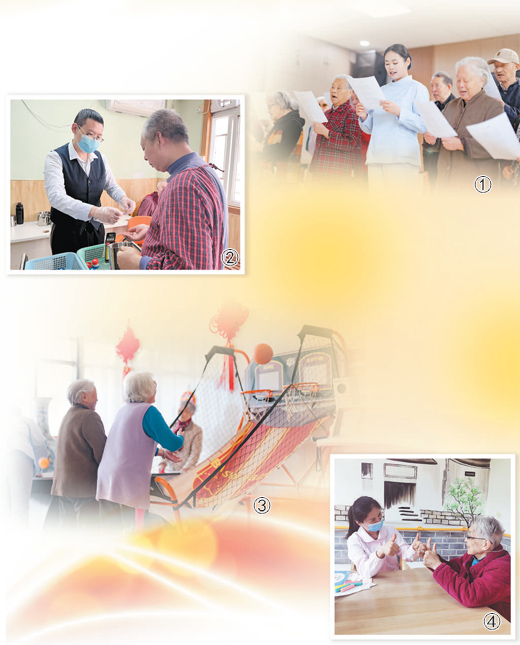
Figure ①: Zhang Yixin, an intern at Dianjiangtai Social Welfare Institute in Nanjing, Jiangsu Province, takes the old people to practice chorus.
Photo by Ma Taotao
Fig. 2: Xing Hongzhi, a nurse of Jiangtaitai Social Welfare Institute, gives medicine to the elderly.
Our reporter Yao Xueqing photo
Fig. 3: The elderly in Dianjiangtai Social Welfare Institute carry out sports activities.
Photo by Ma Taotao
Figure ④: Ni Yan, deputy director of the nursing area for the disabled and demented elderly in Dianjiangtai Social Welfare Institute, takes the elderly to relax after cognitive training.
Zheng Jing photo
Layout design: Shen Yiling
It is both a "family matter" and a "state matter" for the elderly to enjoy their old age. The results of the seventh national census show that the population aged 60 and over in China has reached 264 million. It is estimated that this number will exceed 300 million during the 14th Five-Year Plan period, and China will enter the stage of moderate aging from mild aging.
On the eve of the Spring Festival this year, General Secretary of the Supreme Leader pointed out in a video connection with the elderly and nursing staff in Fuzhou Social Welfare Institute, Fujian Province that "China’s society is aging more and more, so we must let the elderly have a happy old age and vigorously develop the cause and industry of providing for the aged". Report to the 20th CPC National Congress, the Communist Party of China, proposed "implementing the national strategy of actively responding to the aging population".
The development of old-age care and old-age care industry can not be separated from the construction of high-quality and professional talents. In November, 2021, the Central Committee of the Communist Party of China and the State Council issued the Opinions on Strengthening Aging Work in the New Era, proposing to speed up the construction of professional and technical, social services, business management and scientific research talents and volunteers to meet the needs of aging work in the new era. In December of the same year, the "14th Five-Year Plan for the Development of National Aging Cause and the Service System for the Aged" issued by the State Council proposed to "improve the talent incentive policy" and "broaden the ways of talent training".
Encouraged by the policy, in recent years, a large number of young people have actively participated in the development of old-age care and old-age care industry, some engaged in the career of old-age care workers, and some opened nursing homes … … They learn skills, skills and strong skills in their posts, and guard the most beautiful "sunset red" with youth. In 2021, the Ministry of Civil Affairs and Ministry of Human Resources and Social Security jointly held the National Vocational Skills Competition for Aged Care. Of the 128 finalists, about half had a bachelor’s degree or above, with an average age of 29 and the youngest 21.
How do young people bloom their youthful dreams in the pension industry? What new vitality have they injected into the old-age service talent team? How do relevant colleges and universities train and deliver high-level aged care service talents? Recently, our reporter visited Jiangsu, Hunan, Beijing, Shanxi, Heilongjiang and other places.
Starting from today, the reporter’s investigation version has successively launched a series of reports on "Young people approaching the pension industry", so please pay attention.
Gently take off the old man’s coat, help her lie flat on the bed, and then help the old man take off his socks to show his ankles — — Just after Zhang Yixin finished these operations, the nurse pushed the ECG machine to the bedside and began to check for the elderly.
"Cold, a little cold." The old man is a little uncomfortable.
"Grandma, this is alcohol. It will be fine soon. Hang in there." Zhang Yixin comforted softly.
In the morning, Zhang Yixin, a 21-year-old sophomore in Zhongshan Vocational and Technical College, left school and went to Dianjiangtai Social Welfare Institute in Nanjing, Jiangsu Province. He went into the nursing area for the disabled and demented elderly on the third floor of Kangfu Building, put on a bun, put on a light blue nursing suit and started his day’s work. In Dianjiangtai Social Welfare Institute, where Zhang Yixin practiced, there are still a group of post-80s and post-90s youths who are busy in nursing front-line and technical management positions.
Recently, the reporter made an investigation in Dianjiangtai Social Welfare Institute, approached the young groups such as interns, aged care workers and managers here, got a close look at their daily work, and listened to their thoughts and expectations.
Intern Zhang Yixin — —
"By learning by doing and practicing things, we have developed our skills and played a dynamic role in applying what we have learned."
At 8 o’clock in the morning, when Zhang Yixin came, he was just catching up with the welfare home to do a physical examination for the elderly in the nursing area for the disabled and demented elderly.
"Blood test and urine retention first, then electrocardiogram and B-ultrasound, and finally medical examination, so that the elderly can have breakfast early" … … After Ni Yan, the teacher and deputy director of the nursing area for the disabled and demented elderly in the welfare home, Zhang Yixin listened and wrote down, and at the same time did some auxiliary work as much as he could.
"It is much more complicated to do a good job in old-age care than to go to school in books." For example, Zhang Yixin, who is studying smart health care service and management at school, said, "‘ Disability ’ ‘ Dementia ’ ‘ Pressure sore ’ It used to be a professional word for me. When I came here, I realized that behind each type, the situation of each old man is different. "
At about 9 o’clock, Zhang Yixin helped Yang Xin, the old man who had completed the physical examination, to go back to his room and get ready for breakfast. Breakfast that day included rolls of flowers, eggs and oatmeal porridge, which were put on the trolley and divided into three types: normal, broken and mushy. Yang Xin suffers from Alzheimer’s Harmo’s disease, but she can take care of herself when eating. Zhang Yixin helped her choose a good meal and sat beside her to take care of it.
Aside, Ni Yan carefully checked the physical examination items of the elderly and reminded Zhang Yixin, "Grandma Yang worked as a kindergarten teacher, and playing some games can arouse her good memories."
According to Ni Yan’s instructions, after dinner, Zhang Yixin took Yang Xin to paint children’s picture books, and the old man was really very happy.
"Why do you apply for a pension major?" While the old man was painting, the reporter chatted with Zhang Yixin.
Zhang Yixin, who studied sketching, originally wanted to choose fashion design when he applied for secondary school in 2018. During the enrollment consultation, the teacher of Nanjing Xuanwu Secondary Vocational School introduced her to the specialty of aged care service and management, and invited students to visit the old-age care institutions before entering the exam.
"When I visited, I found that the nursing home was very different from what I had imagined. There are many caregivers who are young people. They play the piano and sing to the elderly, and the old people are happy to beat. " Zhang Yixin said.
This visit changed her career plan. "I believe that young people must be useful in the aged care service industry." Zhang Yixin reported the major of aged care service and management. After graduating in 2021, she took the vocational college entrance examination and went to Zhongshan Vocational and Technical College for further study.
"The secondary school is mainly about learning theoretical courses, and there are many practical courses in junior college, such as patting the back and turning over, wheelchair transshipment, etc." Zhang Yixin said, "During the junior college, we have to complete an internship course with a duration of not less than 40 weeks. The school helps us to contact the internship base, and Dianjiangtai Social Welfare Institute is one of them. During the internship, we will go to various departments and positions to have a comprehensive understanding of the aged care service industry. "
What did you get from the internship? During the interview, the reporter met many interns, including Zhang Yixin, and "increasing knowledge" and "improving skills" were the key words they said the most. For example, there is only one sentence in the book "Observing the mental state, diet and defecation of the elderly". In practice, how to feed the disabled and semi-disabled elderly without choking? Food temperature, body inclination, feeding speed, etc., are all learned; For another example, the book says that "wheelchair transport" requires holding or picking up disabled elderly people. But some old people are very heavy, how to hold them? According to the trick of "saving power" taught by the teaching teacher, you can move the old man who is dozens of pounds heavier than yourself … …
During the internship, eight interns, including Zhang Yixin, held an interactive activity for some elderly people in welfare homes: demonstrating simple and easy-to-learn body dance, and some elderly people with slight mental retardation and flexible hands and feet followed suit; Play old songs with lively melody and easy to remember lyrics, and some old people in wheelchairs hum and beat … …
In this activity, Zhang Yixin is both a participant and an organizer. During her school years, she set up an activity planning service studio for the elderly with students majoring in pension service and management, music and art, and cooperated with three pension institutions to provide them with a package from creativity to organization and implementation. This entrepreneurial project won the first prize of Nanjing Vocational School Entrepreneurship Competition. This activity is the creative application of the studio.
"In doing middle school and practicing things, we have developed our skills and played a dynamic role in applying what we have learned." Zhang Yixin said.
Xing Hongzhi, an aged care worker — —
"Old-age care service is not a single life care. It requires patience, hardship and emotional work."
Get clean clothes and towels ready. At 1 pm, Xing Hongzhi, a nurse in the nursing area for the disabled and demented elderly in Taiwan Social Welfare Institute, is invited to usher in the busiest time of the day — — Bathe the old man.
Li Wen, a 78-year-old man, suffers from scoliosis, muscular atrophy and other diseases, losing his ability to take care of himself, and can only rely on nurses to scrub his body in bed every other day. Xing Hongzhi turned on the air conditioner, raised the room temperature to 25 degrees Celsius, connected a large bucket of warm water of about 40 degrees Celsius, tried the water temperature with his wrist, and found a big sheet with a bundle at both ends, tied to the railing at the end of the bed, which began to scrub for the elderly.
"We should protect the privacy of the elderly and make them feel respected." Before scrubbing, Xing Hongzhi tried the water temperature with his wrist again before wetting the towel, and gently wiped it from his face to his arms, chest, abdomen and legs.
Xing Hongzhi, born in 1993, is a boy from Northeast China. After graduating from Dalian Vocational and Technical College in June 2014, he worked as a nurse in Dianjiangtai Social Welfare Institute. For nursing staff who have just graduated, welfare homes usually arrange them to take care of the elderly. However, as a scarce male nurse, Xing Hongzhi volunteered to work in the nursing area for the disabled and demented elderly with greater work intensity.
Scrubbing the body for the elderly is the first problem that Xing Hongzhi encountered after he joined the company. "There are many grandmothers in the welfare home. I am a big old man, and it is inevitable that I will be embarrassed when I care." Xing Hongzhi recalled, "Later, I overcame the psychological barriers and bravely took this step, mainly because of the words of the teacher: ‘ Treat them as your grandparents and take care of them with all your heart. ’”
"In our line of work, we must be patient, persistent and hard-working." Xing Hongzhi shared his experience in this way. When he first joined the work, he was arranged to care for an elderly person with disability, dementia and ADHD. The old man was incontinent and active, which often made him in a hurry. To this end, he goes to work every day and brings several sets of change clothes.
This kind of work experience made Xing Hongzhi unexpected. He once wanted to resign. Unexpectedly, my parents objected: I didn’t want you to do this job because I didn’t want you to suffer. But since you chose to do it, how can you give up so easily? There will be many difficulties in life, so you can make a decision after you get through this.
After several ideological struggles, Xing Hongzhi chose to stay. This stay is nine years. In the past 9 years, nursing the seriously ill elderly and sending them to hospital urgently … … He overcame one difficulty after another, dealt with one complicated situation after another, and made friends with many old people.
Xing Hongzhi not only takes care of the elderly in his life, but also uses his heart to meet their spiritual needs. Grandma Wang, who lives in the nursing area for the disabled and demented elderly, is suffering from a variety of serious diseases. She was transferred from the hospital to Dianjiangtai Social Welfare Institute a few days ago and entered the stage of hospice care. Xing Hongzhi visits before work every day, holding the old man’s hand, playing a piece of music she likes, and sitting by the bed to talk with her for a while.
Not long ago, Xing Hongzhi and his friends launched the activity of "I give the elderly a wish" in the welfare home. Grandma Wang had always wanted to go to Tiananmen Square to watch the national flag being raised, so Xing Hongzhi helped the elderly to fulfill their wishes through live video broadcast on mobile phones.
"Old-age care service is not a single life care. It must be patient, hard-working, and work with feelings to let the elderly enjoy their old age." Xing Hongzhi said.
Technical expert Ni Yan — —
"study hard, work carefully, and do a good job of mentoring"
Wu Lin, a disabled old man who stays in bed all the year round and relies on nasal feeding, has lived in Dianjiangtai Social Welfare Institute for 13 years. So far, he has zero pressure ulcers and zero pneumonia. How did he do it?
When the reporter interviewed, she was catching up with Ni Yan to carry out case teaching in front of Wu Lin’s bed. "Old people who eat with nasal feeding tubes for a long time should be carefully cared to prevent reflux esophagitis and pneumonia, especially before nasal feeding, check whether the nasal feeding tubes have fallen off." Ni Yan demonstrated the operation and explained it to the nurses and interns around her.
"We have learned that for the elderly who have been in bed for a long time, when using nasal feeding, the bedside should be shaken up and the angle should be adjusted to between 30 and 45 degrees. How to measure accurately in practice? Which angle is the most comfortable for the elderly to stay in bed? " Aside Zhang Yixin asked.
"That’s a good question!" Ni Yan gave a live demonstration, crouching, and slowly shaking up the bedside. The reporter saw that with the rise of the bedside, the pointer of an instrument embedded in the center of the bedside was also slightly rotating, and finally stayed at a 45-degree position. Ni Yan said: "This is a bedside protractor, which is specially used to help nurses adjust the bedside angle."
"In the range of 30 to 45 degrees, how high the specific adjustment is depends on the height and weight of the elderly. If you shake it high, the elderly will easily slide down. If it is low, it may lead to food reflux. " Ni Yan said that in order to find the best angle, a few years ago, she and several colleagues of different heights and sizes took a sip of water and lay on the training bed, then slowly debugged to see which angle would not be choked, and recorded them one by one.
"I finally found that if the elderly are obese or the mattress is thick, it can be adjusted to about 30 degrees; A thinner old man like Wu Lin is adjusted to 45 degrees. At the same time, in order to reduce the friction caused by sliding, you can also put a pillow under your feet. " Ni Yan continued to patiently explain, "According to the body, weight, mattress thickness and other information of the elderly, we can always find the most comfortable angle for the elderly by operating according to the data."
After nasal feeding, Ni Yan gently raised Wu Lin’s nasal feeding tube, and took a nurse to observe it closely: the lower part of the nasal cavity was slightly red and the tongue coating was not very dry.
"The old man has a nasal feeding tube to prevent nasal pressure sores and dry mouth." Every time Wu Lin is replaced with a nasal feeding tube, Ni Yan will put it in a slightly different position from the last time, so that the skin in the nasal cavity will take turns to be stressed. At the same time, the cotton swab will be dipped in normal saline every day to wipe the tongue coating for the elderly. "The elderly with nasal feeding tubes breathe with their mouths open every day, which makes them thirsty. This method can keep their mouths moist."
With meticulous nursing service, in 2021, 34-year-old Ni Yan was hired as the deputy director of the nursing area for the disabled and demented elderly in Dianjiangtai Social Welfare Institute. In the same year, she won the first prize in the National Vocational Skills Competition for Aged Care.
Ni Yan not only devotes herself, but also carries out case teaching for young nurses and interns on a regular basis. Together with the technical backbones in the hospital, she compiles the technical points and experiences accumulated in caring for the elderly into "Rules of Life Care Service", which is distributed to every nurse by the welfare home. "The position of the cradle and skin care when the elderly are fed by nose" is one of the chapters.
"study hard, work carefully, and do a good job of mentoring." Today, taking care of more than 40 elderly people in the nursing area for the disabled and demented elderly every day, Ni Yan is busy and full.
Manager Chang Juan — —
"Carry out more school-enterprise cooperation, promote the deep integration of Industry-University-Research, and young people in the pension industry have a place to use."
One afternoon during the reporter’s interview in Dianjiangtai Social Welfare Institute, Shi Jinwu, director of the Department of Smart and Healthy Pension Service and Management of Zhongshan Vocational and Technical College, came to the welfare home with two teachers to discuss the teaching arrangement of a course with Chang Juan.
Chang Juan, born in 1982, won the special prize of the third national vocational skills competition for aged care workers in 2015. At present, she is the chief of the quality management section of Dianjiangtai Social Welfare Institute, responsible for training young care workers.
Since 2019, Dianjiangtai Social Welfare Institute has carried out school-enterprise cooperation with Zhongshan Vocational and Technical College. Chang Juan, who is also a special expert in the college, teaches nursing practical courses to students regularly as a corporate tutor, and participates in the discipline setting and teaching scheme design of related courses in the college.
Shi Jinwu came to Chang Juan to discuss the course "Operation and Management of Pension Institutions", which was suggested by Chang Juan and other experts three years ago. Turning over the course materials, the reporter saw that the teaching content is a combination of law, accounting, human resource management, psychology and other multidisciplinary professional knowledge.
"We combine the experience accumulated in the operation of welfare homes to jointly develop course materials and teaching contents with schools." Chang Juan introduced that in order to make the course closer to reality, she set up the content of "simulated nursing home" for teaching, and teachers and students played roles. "For example, around the problem of poor food complained by the family members of the elderly, please ask them to play the roles of director of nursing department, chief of catering department, dean of nursing home and family members of the elderly, improvise, simulate possible problems and discuss solutions."
Although the method is good, how to do a good job in class in practice? This stumbles Shi Jinwu: "In reality, students have never dealt with each other, and it is difficult for them to play the role of director of nursing department and chief of catering department according to book knowledge;" What questions will be raised by family members, and teachers mostly rely on imagination. "
This time, Shi Jinwu discussed with Chang Juan to solve this problem. After understanding the situation, Chang Juan gave the other party several data compilations, all of which were the latest cases encountered in the management of welfare homes in the past two years. "How to better solve the opinions put forward by family members, how to deal with emergency medical treatment for the elderly, etc., each case has detailed records and can be moved directly into the classroom. We can also send employees to the classroom to reproduce the scene at that time. " Chang Juan said.
In recent years, more and more colleges and universities have come to the welfare home to seek Chang Juan’s cooperation. She volunteered as a corporate tutor in three vocational colleges. She compares herself to a bridge: one end is connected to the school, which makes students’ classroom learning closer to "actual combat" and cultivates a team of nurses who meet the needs of the industry; One end is connected with the market, and the latest research and development achievements and advanced equipment of the school are applied to the service for the elderly in welfare homes in time. "Carry out more school-enterprise cooperation to promote the deep integration of Industry-University-Research, and young people in the pension industry will be useful." Chang Juan said.
Walking into the training building of the welfare home, a group of young nurses wearing VR (virtual reality) glasses are carrying out nursing training.
Under the guidance of Chang Juan, the reporter also put on VR glasses and smart bracelets, and an old man lying in bed and waiting for care appeared in front of him. According to the instructions such as "turn over" and "feed" issued by the voice prompt, the reporter tried to operate: help the elderly turn over, shake up the bedside and feed the elderly … … After the operation is completed, the system immediately reports the total score and corresponding deduction points, and simultaneously displays which operations are not standardized enough and what needs to be improved.
"This kind of high-tech product is developed and produced by Zhongshan Vocational and Technical College in conjunction with a third-party company, which is more realistic than the previous props training using dummies." Chang Juan said.
Chen Fang, Deputy Director of Nanjing Civil Affairs Bureau — —
"Optimize the treatment guarantee, carry out competition instead of training, and encourage more young nurses to grow into talents"
After working for 9 years, Xing Hongzhi’s nursing ability has been continuously improved, and his income has also risen: now his monthly fixed salary is more than 3,200 yuan, his performance salary is more than 2,200 yuan, and his post allowance is 800 yuan.
"The post allowance is issued by the municipal finance." Xing Hongzhi introduced that according to the subsidy policy for employees in Nanjing pension service institutions, employees engaged in pension services in pension institutions can receive a certain post allowance every month according to their working years and skill levels. "I have obtained the certificate of senior vocational skill level of pension caregivers, and combined with working years, I can receive the highest post allowance 800 yuan every month."
"In accordance with the spirit of relevant documents, the city has introduced policies such as the payment of post allowances for employees of old-age services and the settlement of points, and adjusted the post allowances that were originally linked to working years to be linked to working years and skill levels; The method of settlement of points is to add 3 points and not more than 30 points from the original service every year, and adjust it to add 10 points and not more than 50 points every year. " Chen Fang, deputy director of the Civil Affairs Bureau of Nanjing, said that we have strengthened the comprehensive incentives for employees in aged care services and supported employees in aged care services to participate in skill competitions. "Individuals who win prizes in national, provincial or Yangtze River Delta regional skills competitions for aged care workers are awarded honorary titles such as Nanjing technical experts and recommended to participate in the municipal model worker selection."
In March of this year, the Nanjing Workers’ Vocational (Industry) Skills Competition for Aged Care came to a successful conclusion, and four players from Taiwan Social Welfare Institute won the top four. Ni Yan, the head coach of four players, said with a smile: "These young people will continue to go out and participate in provincial and national competitions." In 2021, Ni Yan started from the Nanjing Competition, braving all the way, won the first prize of the National Vocational Skills Competition for Aged Care in that year, and was awarded the title of National Technical Expert.
"Optimize the treatment guarantee, carry out competition instead of training, encourage more young nurses to grow into talents, and continue to promote the construction of the old-age nursing talent team." Chen Fang introduced that in the past five years, in the national and provincial skill competitions for aged care workers, Nanjing won four and eight prizes respectively.
"Their experience shows that the development channel of young aged care workers is becoming more and more smooth." Chen Fang introduced that at present, there are nearly 14,000 employees in Nanjing’s aged care service, and more than one-third of them are born in the 1980s and 1990s. During the "Fourteenth Five-Year Plan" period, Nanjing will train about 10 national and provincial technical experts in the field of aged care services, about 100 heads of leading aged care services, more than 3,000 new aged care workers, and carry out about 30,000 trainings in the field of aged care services.
"In the future, I believe that more young caregivers will glow and grow into talents in the aged care service." Chen Fang said.
(The old people in the text are all pseudonyms)
People’s Daily (13th edition, May 19, 2023)