Sudden! Japanese media report: The Bank of Japan is arranging to raise interest rates next week.
The preliminary results of Friday’s salary negotiation will be crucial …
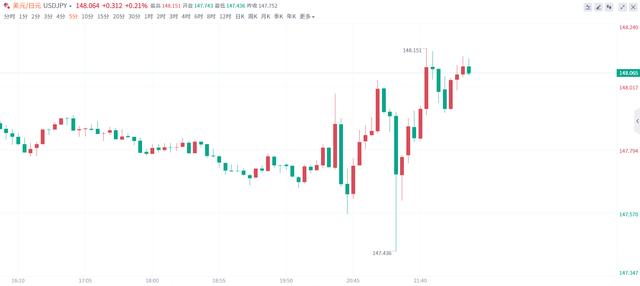
On Thursday, the Japan News Agency reported that,The Bank of Japan plans to end the negative interest rate policy at its meeting in March.As soon as the news came out, the USD/JPY dived nearly 50 points in a short time, but then recovered all lost ground and returned to above 148.
The media reported that,The Bank of Japan will end the negative interest rate policy at the interest rate meeting to be held next week, and pointed out that it will make a final decision after studying the preliminary investigation results of this year’s spring fight on the 27th.. Earlier, the Nikkei News also reported that the Bank of Japan will discuss withdrawing from the negative interest rate policy next week.
At present, the rising wages of major Japanese enterprises are making inflation close to the central bank’s 2% inflation target. As more and more Bank of Japan policymakers accept this idea, whether to raise interest rates is expected to depend on the outcome of Japan’s annual salary negotiations, which will be announced by the Japan Federation of Labor on Friday.
This week, some large Japanese companies announced that they would raise wages, which exceeded the level in 2023, which aggravated the optimistic expectations of the market for the wage growth trend, and thus provided space for the central bank to make important policy changes.
Toyota Motor Corporation, Japan’s largest company by market value, said on Wednesday that it had fully agreed to the union’s demand for a pay increase, which was a record high.Wages in the entire automobile industry have increased by 5% or more.. According to the Japan Metal, Machinery and Manufacturing Workers’ Association, the average salary increase of 60 affiliated trade unions is5.32%, much more than last year’s level. Mari Iwashita, an analyst at Daiwa Securities, said that this "provides favorable conditions for policy adjustment".
Ending the negative interest rate that has been implemented since 2016 will mark a milestone for the Bank of Japan from its massive stimulus plan and its first rate hike since 2007.
However, earlier, some people familiar with the matter said that the interest rate hike in March was not certain becauseSome of the nine members of the Bank of Japan are worried about recent signs of weak consumption, which highlight the fragility of Japan’s economic recovery.
They said that if policymakers feel it necessary to examine more data, such as the business confidence survey to be released on April 1, and the Bank of Japan’s quarterly report on Japan’s regional economy, the Bank of Japan may postpone its decision until April. In addition, most economists also expect the Bank of Japan to "do it" in April.
Hideo Hayakawa, former chief economist of the Bank of Japan who accurately predicted the adjustment of the Bank of Japan’s yield curve control (YCC) policy in July last year, said that after adjusting the forward-looking guidance this month,It will be more reasonable for the Bank of Japan to cancel the negative interest rate policy in April.. He said:
"As of the latest meeting, the Bank of Japan’s forward-looking guidelines still tend to be monetary easing, and the central bank intends to lag behind the curve in policy. Bank of Japan Governor Kazuo Ueda may be highly aware that the bank’s past exit was regarded as a failure. Given that the Bank of Japan is currently trying to lag behind the curve, it is possible to continue raising interest rates after the end of zero interest rates. "